Wednesday, October 19, 2011

Cassandra’s Recipe for Apple Pan Dowdy

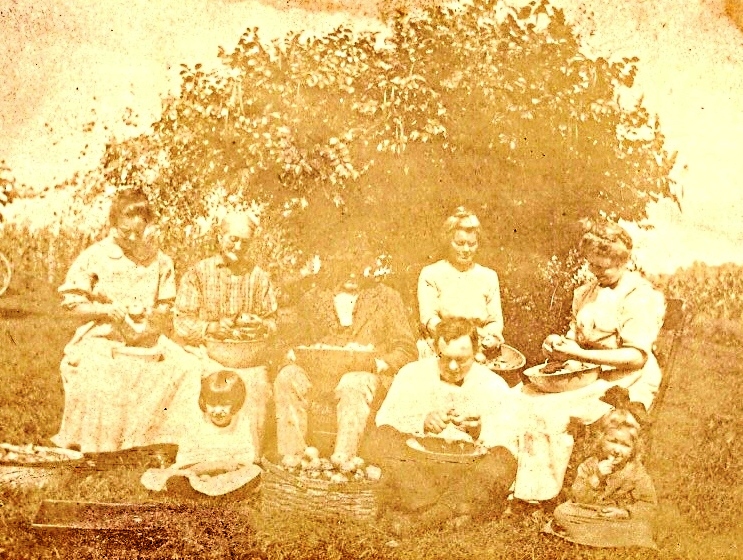
An Old Photo of a Family Peeling Apples Found by Cassandra in Indiana this Past Summer

“…apple pan dowdy makes your eyes light up and your tummy say, ‘howdy’…”


An easy, delicious recipe for using all those wonderful, fresh, ripe autumn apples: 


Preheat oven to 350 degrees. 


Peel, core and cut enough apple slices to fill a medium iron skillet.  (Cassandra loves her new cabinet-mounted apple peeler/corer – only $8.99 at Christmas Tree Shops!) 


Mix together ½ cup brown sugar, ½ cup butter, 2 tsp. cinnamon, and a sprinkle of nutmeg.  Pour mixture over apples. 


Add 2 more cups brown sugar over top and cover with ready-made crust (Cassandra's favorite is Mrs. Smith's frozen Oronoque Orchards™ Deep Dish Pie Crust).  Prick top and bake 1 hour at 350 degrees. 


Serve warm with vanilla ice cream, whipped cream or by pouring warm milk over the dowdy in a bowl.    


Enjoy while listening to Dinah Shore’s famous rendition of the song, Shoo Fly Pie and Apple Pan Dowdy, from the late 1940s! 

Tuesday, October 18, 2011

Falling Leaves

From an antique book, Falling Leaves: Songs and Sketches arranged by E. Nesbit & Robert Ellice Mack, which I recently purchased in upstate New York...


Monday, October 17, 2011

Shop Windows of Paris

(Photos taken by Cassandra)
On a recent trip to Paris during “Fashion Week,” I thoroughly enjoyed the many shopping and “window shopping” opportunities.  The French term for window shopping, faire du lèche-vitrine, translates directly as “to go window licking.” Of course the shop windows were filled with fabulous fall haute couture, but I chose to photograph some more varied items during my three days of walking the streets of Paris…


Au revoir!

Tuesday, September 20, 2011

In the Days of the Golden Rod

(All photos taken at or near Cassandra's upstate New York farmhouse.)


Across the meadow in brooding shadow
I walk to drink of the autumn's wine­
The charm of story, the artist's glory,
To-day on these silvering hills is mine;
On height, in hollow, where'er I follow,
By mellow hillside and searing sod,
Its plumes uplifting, in light winds drifting,
I see the glimmer of golden-rod.

In this latest comer the vanished summer
Has left its sunshine the world to cheer,
And bids us remember in late September
What beauty mates with the passing year.
The days that are fleetest are still the sweetest,
And life is near to the heart of God,
And the peace of heaven to earth is given
In this wonderful time of the golden-rod.

 by Lucy Maud Montgomery


Sunday, September 11, 2011

Summer Sunset

(Photos recently taken by Cassandra at her upstate New York farm...)


Sweet day of summer balm and rest,
Oh, stay thy flight!
Still wave, above yon mountain's crest,
Thy banners bright!
Still hold the portals of the west
Against the night!

Lo!  how the waving forest trees
Beckon they stay!
Hark, how the fragrant evening's breeze
Doth woo delay!
While thrushes plead across the leas,
Pass not away!


But though all nature join the cry,
Not yet - not yet!
Behind yon rocky rampart high
Thy sun will set!
Each bird will hush - each floweret's eye
With tears be wet!

E'en now beyond the purpling hill
Thy light hath past:
The woodland shadows, silent chill--
Are o'er me cast.
The while thou wingest, tireless till
Thou gild the east!


The Father knows we cannot bear
Unclouded light;
Therefore each perfect day must share
With darksome night --
Until He bring that dawning fair,
Eternal--bright!

~ George S. Dwight, from The Cool of the Day, 1892


Friday, July 29, 2011

A Beloved Childhood “Friend”…

On my new rocking horse, "Billy"
- note mother hiding on the left holding me on!
When I was one year old, my parents received a call from my father’s office, telling them that a package addressed to me had arrived there from Marshall Fields in Chicago, sent by a client/friend of my father.   When they arrived at the office to retrieve this mystery box, my parents were amazed that the “package” was actually a very large wooden crate in which was packed a beautiful large German rocking horse or Schaukelpferde.


Cowgirl Cassandra on Billy at age 3.
I named my horse “Billy” - he sported a real horsehair mane and tail; red wooden, western-style stirrups; a real leather bridle and reins; a glossy painted bright gold saddle; beautiful hand-painted eyes; a soft brown velvet painted coat; and a red bow-style rocker.  Billy was a beloved part of my early childhood years and those of my sisters and friends. 

Billy ridden by a young friend...
Today Billy resides at the home of my sister and brother-in-law where he is in process of restoration - soon to be enjoyed again by another generation: starting with my new granddaughter, Alice Annabelle! 

A Brief History of the Rocking Horse
For centuries as far back as ancient Greece and Persia, children have been enamored of toy horses, playing kings and queens, knights and damsels, cowboys and cowgirls, & etc., with these timeless toys, whether on a stick, pulled by a string, or built on wheels or rockers. 

Rocking horses first appeared in Europe, notably in Germany, in the seventeenth century and were especially popular in England during the Georgian and Victorian eras, when only the wealthiest of parents could afford such a luxury.  These elaborately handcrafted masterpieces, featured leather saddles and bridles, glass eyes and real horsehair manes and tails and were believed to help develop children's' balance for riding real horses.
Rocking horses were also produced in the United States, as well as in Europe, during the Victorian & Edwardian eras, as the Industrial Revolution introduced a larger and more affluent middle class as well as less expensive productions costs.  In 1880 a Cincinnatian invented and patented the “Safety Stand” or swinger base, which largely replaced the curved “bow” rocker of early years.  Many antique tin-types, cabinet cards, and early black and white photographs of children and their rocking horses can be found in both the U.S. and in Europe. 


Production progressed through the mid-twentieth century, at which time the crafting of fine rocking horses almost ceased.  During the past 20 years there has been an increasing quantity of skilled craftsmen around the world producing and restoring quality rocking horses.

 
A Sampling of Current Rocking Horse Craftsmen…


Tuesday, July 26, 2011

Favorite ♥ Places: The Belmont Manor House, Ashburn, Virginia


For me, one of the best parts of living in the Washington, DC area is the access one has to the many interesting historic sites of the area.  My husband and I were recently invited by friends to a wonderful private 6-course dinner prepared by the chef of the Belmont Country Club in Ashburn, Virginia.  The dinner took place in the clubhouse, which is actually the restored historic Belmont Manor House.  Curious about the Manor House’s history I did a little research and found that the former plantation has been host to a fascinating array of people during its 212 years of existence!


Strategically set with commanding views in every direction of the countryside and the Blue Ridge Mountains on the highest point – a 415 foot ridge - west of Leesburg in eastern Loudoun County, Virginia is the two-story, five-part Federal mansion, formerly known as Belmont Plantation.  The Manor House (listed on the National Register of Historic Places) was built between the years of 1799-1802 by Col. Ludwell Lee (1761-1836) whose father, Richard Henry Lee, was a signer of the Declaration of Independence. 

Richard Henry Lee
The first owner of the property was Thomas Lee (1690-1750), who was given a land grant of 11,182 acres from Thomas, Sixth Lord Fairfax.

Thomas Lee
During the War of 1812, Ludwell Lee’s plantation served as a refuge for President Madison when the British attacked Washington, D.C.  Col. Lee had served in the Continental Army as aide-de-camp to General Lafayette during the American Revolution, so when Lafayette made his final visit to the U.S. in August 1825, Ludwell Lee lavishly entertained the French general, President John Quincy Adams and former President James Monroe at the plantation.

General Lafayette
Although a slave owner, in 1819 Ludwell Lee helped organize the Loudoun Auxiliary of the American Colonization Movement, which assisted freed slaves to travel to the African nation of Liberia as settlers and missionaries.

Following Ludwell Lee’s death in 1836, Belmont was purchased by Margaret Mercer (1791-1846), the daughter of former Maryland Gov. John Francis Mercer. After her father died in 1821, Mercer, a staunch abolitionist, began to free the slaves on the family’s plantation near Annapolis, Maryland and pay their way to Africa via the American Colonization Movement, of which she was a member.  After purchasing Belmont, Miss Mercer immediately opened a progressive Christian school for young ladies, the Belmont Academy, in the manor house, with 20 to 30 boarding students and some from the community.  She offered moral instruction and a rigorous curriculum, including agriculture, sanitation, mathematics, science, astronomy, the natural sciences, and philosophy - subjects not usually taught to young women of that era.  Mercer was blessed with a keen and inquiring mind which led her to pursue extensive studies in medicine, agriculture, public health, and theology, during a period when such pursuits were deemed unsuitable for women. Her insistence that African Americans learn to read and write broke Virginia law and created hostility towards her in the community.  (The Memoir of Margaret Mercer can be downloaded free to computer or Kindle.)
Margaret Mercer 1848 by Thomas Sully
Other notable owners of Belmont include former Kansas Governor Frederick M. Staunton and Mr. and Mrs. Edward B. McLean.  Edward was the son of the owner-publisher of the Washington Post and Evalyn Walsh McLean was the only daughter of a successful Colorado gold miner, who is best remembered as an owner of the famous Hope Diamond.  President Warren G. Harding, a friend of the McLeans, often visited Belmont; and Mrs. McLean is said to have arranged trysts for the President at Belmont.  The McLeans raised and raced thoroughbred horses at Belmont and hosted many equestrian events during their ownership throughout the roaring ‘20s.  The Great Depression affected the McLean’s wealth; and in 1931 they lost Belmont at an auction, and it is said that there was a dispersal sale on the front lawn.  (Evalyn Walsh McLean’s recently updated autobiography, Queen of Diamonds, is a great read!) 

Evalyn Walsh McLean in the Roaring '20s wearing the Hope Diamond
Belmont was next sold to General and Mrs. Patrick J. Hurley for $75,000 - $10,000 less than the price paid by the McLeans.  General Hurley served as President Herbert Hoover’s Secretary of War; and during World War II (when Hurley was called to active duty as a brigadier general and served on a special mission to Australia and as the first U.S. minister to New Zealand, 1942; was a personal representative of the President of the United States to the Soviet Union, 1942, and to the nations of the Near East and Middle East, 1943; and was a presidential emissary and then ambassador to China, 1943-1944) the Hurleys rented Belmont to the Philippine Government-in-Exile for the duration.

General and Mrs. Patrick J. Hurley

Beatrix & Friends...

Frolicking Lambs

Cassandra Follows...