Wednesday, October 13, 2010

My Lady of Autumn

Currier & Ives "Autumn"

My Lady of Autumn, sing me your song
Play me your tune; tell me I'm wrong
Tell me you don't mean the things that you say
Tell me that we'll find a way.

Your eye clear as winter, your touch fresh as spring
You weigh like the summer, free as birds on the wing
The seasons are changing, it's time you were gone
The colors of you will go on.

Fields that were golden are changing to brown
Leaves that were green now tumble to the ground
The warm sun of summer makes way for the snow
I know it's time; you must go.

The light, it is changing, the sky's overcast
Winter is here now, autumn is past
Deep in this dark world some warmth I must find
Though it's winter in the valley, it's still autumn in my mind.

Dave Webber

(Scroll down to the bottom of the page to turn off Cassandra's Blog Music before listening to the video below.)


Currier & Ives' "American Homestead - Autumn"

Tuesday, October 12, 2010

Paper Doll Memories


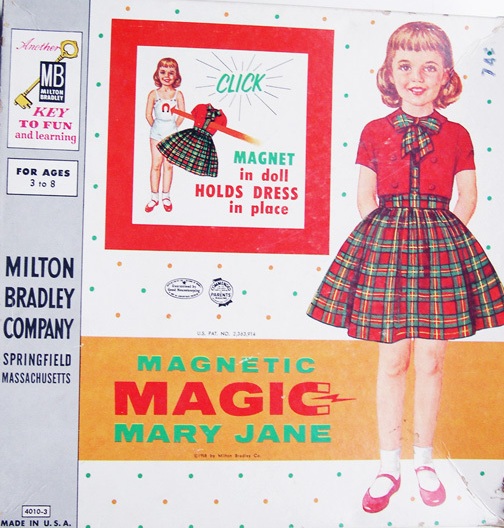
As children during the “Fabulous Fifties,” my sister and I enjoyed playing with paper dolls. Many hours were spent on our living room rug or on that of our Grandmother Lavenua, cutting out and arranging the clothes, accessories, and sometimes even furniture of our paper doll families. Our favorites included brides and grooms; ballerinas; movie stars: Doris Day, Vivien Leigh, Debbie Reynolds, and Elizabeth Taylor; and television stars: Roy Rogers and Dale Evans; the Mousketeers, Cubby & Karen from the "Mickey Mouse Show;" the Story Princess from the “Howdy Doody Show;” and the Lennon Sisters from the “Lawrence Welk Show.”

A special favorite was our magnetic set, “Magic Mary Jane.”

Paper dolls are a wonderful source of history, culture, literature, costume, art, marketing, and nostalgia and have been around as long as there has been paper. In Asian cultures many years ago, faces or other objects were applied to the paper used during religious rituals and ceremonies. More similar to contemporary paper dolls were the “pantins,” the jointed dancing or jumping jack puppets of eighteenth century France. During the eighteenth and nineteenth centuries in Britain, printers printed paper dolls, mixing fun and virtue by printing stories with morals and values to accompany them. Paper dolls were a valuable treasure in early America, since paper was limited.
By the mid-1800s, paper dolls were produced as a beautifully lithographed full-color collection. The artist, Raphael Tuck, was perhaps the best known manufacturer of the vintage paper dolls of this era. The trademark style of this company was the set of vintage paper doll costumes and interchangeable heads.

There were dolls representing royalty, the children of royalty, and actors from the theater, stage, and opera. Early paper doll sets often advertised a particular product, e.g., sewing, bakery, or medicinal products. With the purchase of the product children would receive a doll or outfits.


The Boston Sunday Globe began printing paper dolls in the 1890s. Characters from Harriet Beecher Stowe’s novel, “Uncle Tom’s Cabin,” were the subject of one of its paper doll supplements in 1896.

Women's magazines often came with a page of paper dolls for children to cut out: Ladies' Home Journal (Lettie Lane Series); Pictorial Review (Dolly Dingle); and McCall’s (Betsy McCall). The website, Betsy McCall Paper Dolls: The First Ten Years, features scanned originals from 1951 through 1961, ready to download, cut and play.  Another web site includes a brief history of McCall’s magazine and the history of the Betsy McCall paper dolls.

The popularity of paper dolls soared during the 1930's, 1940's and 1950's. Paper dolls were made and sold representing royalty, public leaders, movie stars, fantasy fairy tale style characters, comic book characters, TV characters, family groups, brides, dancers, stuffed animals, babies, and even cherubs. Public popularity waned somewhat during the 1960s , attributed to the increased popularity of television-viewing and the rise of the three dimensional fashion doll industry, i.e., Barbie, Toni, etc.
A site from which to order vintage and mint uncut paper dolls (as well as a real trip down "Memory Lane") is: http://www.papergoodies.com/scripts/default.asp.  You are certain to locate some of your old favorites!

Monday, October 11, 2010

Cassandra's Favorite Apple Pie

Apple pie has become part of the American consciousness as representative of all that is wholesome and good about our country; a reminder of comfort and innocence. In World War II, when American soldiers were asked by journalist why they were going to war the standard response was “for Mom and apple pie”. It has been said that the Apple Marketing Board of New York State used such slogans as "An apple a day keeps the doctor away" and "as American as apple pie!" and thus was successful in rehabilitating the apple as a popular comestible in the early twentieth century when prohibition outlawed the production of hard cider.

There are American apple pie recipes, both manuscript and printed, from as early as the eighteenth century. Yet, what we consider to be apple pie has been around in Europe since the Middle Ages. Medieval and Renaissance recipes for apple pies or tarts have shown up, in one form or another, in English, French, Italian, and German recipe collections that span centuries and which show a wide variety of ways to prepare apple pie.

English apple pie recipes go back to the time of Chaucer.  The recipe above from 1381 lists the ingredients as good apples, good spices, figs, raisins and pears.  The cofyn of the recipe is a casing of pastry.  Saffron is used for coloring the pie filling.  Cloves are a popular addition, tempering the sweetness in much the same way as cinnamon.  The absence of sugar in the recipe may indicate that, because refined sugar was a recent introduction from the Orient, the medieval English did not have as sweet a tooth as their descendants!
Cassandra's Favorite Apple Pie

Preheat oven to 375 degrees.

For Pie Crust: Cassandra likes Oronoque Orchards (by Mrs. Smith’s) frozen pie crusts

For Filling: (Makes one pie)
3 lbs apples, such as Gala, Cortland, Granny Smith or McIntosh, peeled cored and cut into half-inch wedges.
1 cup sugar
½ cup honey, preferably a local, more flavorful raw honey
½ cup cornstarch
1 tsp vanilla extract
2 tsp ground cinnamon
Zest and juice of one lemon
 
Thaw the frozen pie shells.
In a large saucepan, sift together the sugar and cornstarch, then toss with apples, honey, vanilla, cinnamon, lemon juice and zest. Let stand for 20 minutes.
Bring fruit mixture to a boil over medium heat, stirring constantly until the mixture has thickened slightly, making sure fruit does not stick to the bottom of saucepan. Remove from heat and cool.
Fill thawed pie shell with the fruit filling and then lay the second dough circle over the filling, press very gently around the edges and flute together. With a paring knife or cookie cutter, puncture the top pie dough to form (a) steam vent(s). If desired, sprinkle with cinnamon sugar.
Bake for about 40 minutes or until the pie filling is starting to bubble out the vents and the top pie crust is golden brown. Remove to a cooling rack and allow to cool for 1-2 hours before serving.

Saturday, October 9, 2010

Autumn


Winter is an etching,
Spring a watercolor,
Summer an oil painting,
And autumn a mosaic of them all. 
Stanley Horowitz 

Decorative publishers' editions of the early 20th century with an autumn theme from Cassandra's collection:


Thursday, October 7, 2010

A Lovely Time, Not Very Long Ago...Thank You, Eloise Wilkin!


During her 50 year career spanning the decades of the 1930s through the 1980s, Eloise Wilkin illustrated over 110 books for children.  Her illustrations evoke an idyllic rural world not unlike that which she knew while raising her family of four children in upstate New York.  Famous for her instantly recognizable style: sweet, cherubic, chubby-faced children; detailed early American and Victorian style architecture and furnishings; and the verdant, daisy-strewn hills of upstate New York, Eloise illustrated children’s early reading books; paper dolls; puzzles; entries in the Childcraft series; 20 books authored by her sister, Esther; as well as her 47 popular “Little Golden Books” titles.  Her most beloved titles include We Help Daddy, We Help Mommy, Baby Dear, So Big!, Prayers for Children, Busy Timmy, and My Little Golden Book About God.


In addition to free lance drawing and book illustration, in the early 1960s Eloise successfully designed and marketed, via the Vogue Doll Company, a new-born infant doll about which the popular Little Golden Book, Baby Dear, was later written. Eloise's daughter, Deborah and grandson, David served as the models for the mother and baby in the book. The realistic style of the Baby Dear doll revolutionized the doll industry at the time, encouraging more realistic baby dolls. Reportedly, former Soviet Premier Nikita Khrushchev returned home with several of the dolls after a trip to F.A.O. Schwartz in New York City.


Born in Rochester, New York in 1904, Eloise Burns, was fortunate to have had a mother who encouraged her imaginative children to enjoy their creative gifts, allowing them to draw all over one wall in their house just before redecorating. Her father was a newspaperman and her mother had studied piano at a conservatory and often played classical music, which Eloise grew to love. Eloise, her sister Esther (only fifteen months older), a brother Robert, and two other siblings grew up in New York City on 109th Street near Central Park. As children, Eloise and Esther shared a bedroom and spent hours creating doll houses from orange crates, dolls out of newspapers, and sewing doll clothes. Eloise and Esther, remained especially close, and eventually married brothers, Sydney and George Wilkin. At age 11, Eloise won a drawing contest for children, sponsored by the Wanamaker department stores, with a picture of a pilgrim returning home.


While studying art at Mechanics Institute (now Rochester Institute of Technology), Eloise Burns met Joan Esley, best known as an illustrator of several books for adolescents. They formed a lifelong friendship that included collaboration on a children’s book entitled, The Visit. After graduating from The Rochester Institute of Technology, Eloise and Joan began doing free lance work in Rochester (i.e., Eloise painting stations of the cross for the Sacred Heart Academy Church and illustrations for the Rochester Box Company) and ultimately moved together to New York City, where they hoped to have a better chance at careers in illustration. Eloise’s first book was The Shining Hour for the Century Co. Other publishers for  which she illustrated were Ginn, Scribner, Little Brown, Rand McNally, Random House and MacMillian. Many early illustrations were for school books, i.e., The First Grade Book for Ginn. Early in her career Eloise illustrated paper dolls for Samuel Gabriel & Sons, Playtime House and Jaymar. She illustrated for four years before marrying Sidney Wilkin in 1935, thus, her early works are signed Eloise Burns.


The Wilkins family settled in a fieldstone farmhouse with eight fireplaces in the country near Canandaigua in upstate New York, and Eloise slowed her career for several years while raising her four children, Ann, Sidney, Jr., Deborah and Jeremy. In 1943, she was offered a contract with Simon & Schuster and worked almost exclusively for Little Golden Books, illustrating the 47 little golden books, calendars, shape books, big golden books, and sturdy golden books until 1961; then, only occasionally illustrating for them up until the mid-eighties. Eloise used her neighborhood, her home, her children, her husband, her grandchildren, and their friends and neighbors as models for her illustrations. Many little golden book pages became puzzles which were produced by Simon & Schuster and later Golden Press. Earlier puzzles illustrated by Wilkin have been found produced by Playtime House and Leo Hart Co. Her illustrations are also found on record sleeves of many little golden records (occasionally on the record label itself) and on china plates, ads, Hallmark cards and in Child's Life, Story Parade and Golden Magazines. Currently, original editions of Eloise Wilkin illustrated books in very good condition can command prices of up to several hundred dollars.


It is said that Eloise was very modest about her talents and was a woman who stood up for her beliefs, whether it was refusing to paint pants on a mother in one of her children’s books, marching with Martin Luther King, marching with the Berrigans in Washington early in the Vietnam War, teaching art to inner city children, or assisting a University of Rochester student in the burning of his draft card in Central Park.

In October of 1987, Eloise died of cancer, at the age of 84 in Brighton, New York. At the time of her death, she was working on a new doll and was still illustrating.


In the recently published, A Little Golden Book Collection Eloise Wilkin Stories (featuring nine of her most treasured stories: "Busy Timmy, "Guess Who Lives Here", "Wonders of Nature", "Selections from A Child’s Garden of Verses", "We Help Mommy", "Baby Listens," "Baby Dear," and "Baby Looks"), an afterword by James Werner Watson aptly describes Eloise Wilkin’s legacy:

"A warm and creative homemaker, Eloise shared with the world glimpses of her big, busy, welcoming household, its rooms papered with gentle patterns, its drop-leaf tables and rocking chairs aglow with hand-rubbed sheen, its four-poster beds covered by hand-stitched quilts. A devoutly religious person, she shared ever so gently her values, her sense of the beauty of order and love, of implicit self-discipline, and of regard for others . . . she has left us, only slightly idealized, rich reminders of a lovely time not very long ago."

To listen to a three-part interview with one of Eloise Wilkin’s daughters, Deborah Wilkin Springett, (author of the Eloise Wilkin’s Book of Poems, her mother’s last illustrated book, published in 1988) and to order her biography about her mother, The Golden Years of Eloise Wilkin, go to: http://www.triviumpursuit.com/blog/2007/02/21/podcast-2-interview-with-eloise-wilkins-daughter-part-one/


Beatrix & Friends...

Frolicking Lambs

Cassandra Follows...