Wednesday, February 16, 2011

Fabulous Flamingos!


How I have enjoyed the amazing tropical birds here in Florida this winter!  Last weekend, while visiting the Sarasota Jungle Gardens with my family, we enjoyed a show featuring exotic birds – Macaws and Cockatoos; encountered a white peacock (see below the close-up shot of his lacy tail feathers); and delighted in photographing at very close range the lovely flamingos - talk about “…things bright and beautiful”!!!

Interesting flamingo facts:

♥ Flamingos are generally placed in their own order – Phoenicopteriformes – and recent molecular and anatomical studies have suggested they are related to grebes.


♥ The coloration of flamingo adults ranges from light pink to bright red due to aqueous bacteria and beta carotene obtained from their food supply. A well-fed, healthy flamingo is more vibrantly colored and thus a more desirable mate.


♥ Flamingos “filter-feed” on brine shrimp and blue-green algae. Their oddly shaped beaks are specially adapted to separate mud and silt from the shrimp and algae, and are uniquely utilized upside-down. The filtering of food items is assisted by hairy structures called lamellae which line the mandibles, and
the large rough-surfaced tongue.


♥ Flamingos often stand on one leg, the other tucked beneath the body, which recent research has indicated may allow the birds to conserve more body heat, given that they spend a significant amount of time wading
in cold water.


♥ Flamingos, in glands lining the whole of the upper digestive tract, produce what is known as “crop milk;” and both parents nurse their chicks for about two months until the chicks’ bills are developed enough
to filter feed.


♥ Flamingo tongues were considered a delicacy in Ancient Rome, and ancient Egyptians believed flamingos to be the living representation of the god, Ra.

For more fascinating facts, consult the Flamingo Resources website.

Wednesday, February 2, 2011

Tuesday, February 1, 2011

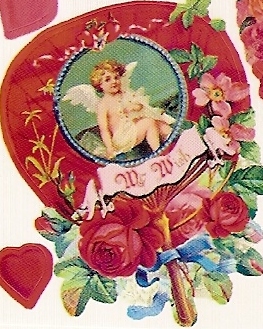
Valentines: A Brief History & a Sampling from Cassandra’s Antique Collection


How do I love thee? Let me count the ways.
~ Elizabeth Barrett Browning

February has been a month of romance since ages past. St. Valentine’s Day originated from Christian and Roman traditions - the Roman Catholic Church recognizes three martyred saints named Valentine or Valentinus. During the Middle Ages in France and England it was believed that February 14 was the beginning of birds' mating season, thus began the practice of celebrating Valentine's Day as a day for romance in the middle of February.

The oldest known valentine still in existence today is considered to be a poem written in 1415 by Charles, Duke of Orleans to his wife while he was imprisoned in the Tower of London following his capture at the Battle of Agincourt. Several years later, King Henry V hired a writer, John Lydgate, to compose a valentine note to Catherine of Valois.

During the 1600s, the holiday began to be popularly celebrated in Great Britain; and, by the mid -1700s, it was common for friends and lovers of all social classes to exchange small tokens of affection or handwritten notes. Due to improvements in the technology of printing in the late 1700s, printed cards began to replace written letters. The manufactured cards made it easier for people to express their emotions in a time when direct expression of one's feelings was discouraged. Less expensive postage rates also contributed to an increase in the popularity of posting valentines.

In the 1840s in Worcester, Massachusetts, a young woman named Esther A. Howland, inspired by the fancy lace-covered English valentines that her father sold in his Worcester stationery store, began to create and sell the first mass-produced valentines in the U.S.


Esther initially created several sample valentines and persuaded one of her brothers skilled in penmanship to inscribe sentiments in the cards. The valentines proved extremely popular - despite their high cost – many sold for $5 to $10 each, and very extravagant ones, bedecked with ribbons, satin, and silk, cost up to $30.

Esther’s business boomed, and she recruited four friends to help her fulfill the orders and created an innovative assembly-line approach in making the cards. Seated at a long table, one worker cut out small colored lithographs of sentimental subjects, the next laid them on brilliantly glazed paper backgrounds, a third assembled the layers of lace paper that framed the central design, and the fourth pasted down a printed sentiment, typically inside the card or under a flap where only the recipient could see it. In 1881, Esther sold her business to the George C. Whitney Company.


While other manufacturers of valentines competed for the affection of the public, none could compete with the quality, taste, and style of Esther Howland. She is credited with having popularized the lace Valentine, and propelling it into a major industry and came to be known as "The Mother of the American Valentine"..

My bounty is as boundless as the sea,
My love as deep; the more I give to thee,
The more I have, for both are infinite.
~ William Shakespeare, Romeo and Juliet


A life without love is like a year without summer.
~ Swedish quote


Being deeply loved by someone gives you strength, while loving someone deeply gives you courage.
~ Lao Tzu


To love is to receive a glimpse of heaven.
~ Karen Sunde


Love is the only gold.
~ Alfred, Lord Tennyson


All thoughts, all passions, all delights,
Whatever stirs this mortal frame,
All are but ministers of love,
And feed his sacred flame.
~ Samuel Taylor Coleridge


I have found the paradox, that if you love until it hurts, there can be no more hurt, only more love.
~ Mother Teresa


Wednesday, January 26, 2011

Margaret Hill McCarter, American Author (1860-1938)


"She dignifies and makes holy the tilling of the soil while not glossing over the hardships of life. It is drudgery, but she makes it a blessed drudgery, glorified by the loves of life, brightened by the higher vision - a drudgery which brings its own reward."
~ William E. Connelley, from A Standard History of Kansas and Kansans, 1918

A Hoosier-born author, brought up on a farm, located between Carthage and Charlottesville in Rush County, Indiana, Margaret “Maggie” Hill was the sixth of seven children of tenth generation Quakers. Her pioneer parents arrived in Indiana in 1858 from Randolph County, North Carolina. Raised in a home that stressed reading and education, Maggie, as a child, was considered shy, retiring and somewhat slow – a dreamer.

She certainly bloomed! After attending the Quaker Earlham College for 2 years, Margaret completed four years of coursework in two years to graduate with a degree in education from the State Normal School in Terre Haute. She began her professional career as an educator in Indiana public schools - near her family home, as an elementary “schoolteacher,"starting at the age of sixteen in 1876; in Rensselaer, as a high school principal; and in Goshen, as head of the English department. In 1888, at the age of 28, Margaret accepted a position as head of the English department at Topeka High School in Kansas, which she continued to fill until 1894.

Kansas became Margaret’s true and beloved home, where she married Topeka dentist, Dr. William Arthur McCarter, also Hoosier-born of pioneer parents, in 1890; raised 2 daughters and a son; and in 1901 began her long career as a prolific author. She edited, with biographical and bibliographical notes, several titles in the Crane Classics series, including: Hawthorne's Great Stone Face; and Miraculous Pitcher; Holmes' Grandmother's Story of Bunker Hill, Longfellow's Song of Hiawatha; Lowell's Vision of Sir Launfal; Shakespeare's King Lear and Merchant of Venice, and Whittier's Snowbound. She contributed poetry and short stories to various newspapers and magazines and authored many famous, well-loved books: A Bunch of Things Tied Up with Strings, 1901; Cuddy, and Other Stories, 1902; The Cottonwood's Story, 1903; Overflowing Waters, 1903; Christmas Eve in the Day Coach, 1905; Cuddy's Baby: A Story of the Kansas Folks; 1907; In Old Quivira, 1908; The Price of the Prairie: A Story of Kansas, 1910; The Peace of the Solomon Valley, 1911; A Wall of Men, 1912; A Master's Degree, 1913; Winning of the Wilderness, 1914; The Corner Stone, 1915; Vanguards of The Plains, A Romance of the Santa Fe Trail, 1917; Paying Mother: The Tribute Beautiful, 1920; The Reclaimers, 1918; Homeland: A Present Day Love Story, 1922; Widening Waters, 1924; and The Candle in the Window, 1925. Margaret Hill McCarter is considered to be Kansas’ first popular female author for her many novels set against the Kansas prairie and for memorializing the early days of the state; and she remains, today, Kansas’ bestselling female author.

“No one has succeeded so well in translating the atmosphere of Kansas prairies and the experiences and ideals of Kansas men and women as has Margaret Hill McCarter, author of Middle West fiction. It has been her task to search out and clothe with fitting words the simplicity and the real grandeur of the people who made Kansas and are still its breath and life.”
~ William E. Connelley

Margaret was also very active in the founding and work of several women’s and literary clubs, historical societies, and civic organizations in both Indiana and Kansas and was well-known as an orator at civic and women’s groups and on the Chautauqua circuit. Her lecture on Abraham Lincoln was said to be one of the “most thrilling and comprehensive that has ever been delivered on this subject.”


Margaret’s participation in state and national Republican Party politics resulted in an invitation to address the 1920 convention, making her the first woman to speak to the national gathering. She was awarded three honorary degrees: a Master’s from Baker University and Doctorates from both Washburn and Emporia universities.

"From the shy child on the Indiana farm to the busy woman who has earned for herself both gold and fame is a far cry - and yet not so far. She began life as a dreamer…'Is your castle in the air?' asks Thoreau, 'Good, that is where it should be. Now put a foundation under it.' And the foundation which Margaret Hill McCarter has put under her air castles is builded on the solid rock.”
~ William E. Connelley

To view more of Margaret’s book covers and other memorabilia, click here. 

Monday, January 24, 2011

"Bright Ideas for Entertaining" for Valentine’s Day


(Another in a series of ideas for entertaining - before the advent of television and computers - from Cassandra’s antique1905 book, Bright Ideas for Entertaining, by Mrs. Herbert B. Linscott.)


"This description of a Valentine entertainment will be welcomed by those who desire novel and original ideas.

"We were received in a room decorated with wreaths, hung in festoons caught up at regular intervals by ribbon streamers. From the centre of each wreath hung hearts of parchment paper, tinted in blue and lettered in gold, each bearing a number and a fate of fortune."

"Suspended from a portiere rod between the hall and reception room were three hearts formed of heavy wire and carefully entwined with evergreen; above each one was a jingle. The first said:  Blow your bubble right through here, and you’ll be married before another year.  Above the second was: To be engaged this very week, number two is the one to take.  And the third had: A sad, an awful fate awaits the one who seeks me, for he or she will ever a spinster or bachelor be."

"On a small table nearby was an immense bowl filled with sparkling soapsuds, and also clay pipes decorated with little hearts. We first threw the bubbles off the pipes and then tried to blow them through hearts one and two with pretty little fans which were presented to us…"


"After this came a still merrier game. A low scrap basket was placed in the centre of the room, and the company arranged into opposing parties, forming two half circles around the basket. Cardboard hearts in two different colors were given the sides, an equal number to each side. We were then requested to try to throw them in the basket…When we had exhausted our cards those in the basket were counted, and the side having the most of its own color won the game."

"After this, a small blackboard was placed on an easel at one end of the room, and we were each in turn blindfolded, and handed a piece of chalk with which to draw an outline of a heart, and to write our name in the centre; the one doing the best to have a prize of a large candy heart."

"The partners for supper were chosen in a novel manner, the men being numbered, and the names of the girls written on slips of paper, rolled in clay in little pellets, then dropped into a bowl of water; the one to rise first belonged to the young man numbered one, and so on until each had his Valentine."


"A “Good Luck” supper was served in an adjoining room. Over the table, suspended from the chandelier, hung a floral horseshoe. In the centre and at each end of the table were fairy lamps surrounded by smaller horseshoes. The souvenirs and everything connected with the supper bore a symbol of good luck, the bonbons, cakes, and sandwiches taking the forms of either a clover-leaf or a horseshoe."

Friday, January 21, 2011

Dutch Oven Cooking


The current cold and icy winter weather beckons Cassandra to prepare some delicious dutch oven comfort food:

Braised Viennese Pork Roast with Heirloom Potatoes

Makes 6 servings.

3 lb boneless pork loin roast
1/4 c bacon drippings
1 c chopped onion
1 c chopped carrot
1 Tbsp Hungarian paprika
3/4 c chicken broth
2 Tbsp all-purpose flour
1/2 c dairy sour cream
1/4 tsp caraway seed
1 tsp chopped capers
1 Tbsp snipped fresh parsley

In Dutch oven, brown pork loin roast in bacon drippings; set aside. In remaining drippings, cook onion and carrot until tender but not brown. Stir in paprika. Lay roast atop vegetables; add chicken broth.

Bake, covered, in 350 degree F oven for 1 to 2 hours, or until meat thermometer registers 170. Remove roast to serving platter; keep warm.

Gravy: Strain pan drippings; discard vegetables. Measure pan drippings; skim off excess fat. Add water to drippings, if necessary, to measure 1 cup. Return to Dutch oven. Blend flour into sour cream; stir into liquid in pan. Cook and stir till thickened and bubbly. Stir in caraway seed, capers, and parsley. Serve with roast.

Serve roast and gravy with steamed heirloom potatoes and crusty whole grain bread & butter.

Tuesday, January 18, 2011

Sarah Wyman Whitman, Artist & Designer


Descended from prominent New England families, Sarah Wyman spent her early childhood in Baltimore among her Wyman relatives, in a cultivated and philanthropic environment. When she returned to Lowell, Massachusetts, at 11, she was educated at home by a gifted tutor, who shaped her lifelong dedication to learning.

After her marriage to successful Boston wool merchant, Henry Whitman, their move to Beacon Hill, afforded Sarah access to the wider world of the Boston elite: artists, writers, and educators. In 1868, she entered the studio of the successful, socially prominent  artist William Morris Hunt, who had only recently begun to welcome women as students.

Whitman's professional training was astonishingly brief. She studied with Hunt for three winters, studied drawing with his colleague William Rimmer, and twice—in 1877 and late 1878 or early 1879—went to France to study with Hunt’s former master, Thomas Couture. Although she lacked “just one year in the Academy,” considered a prerequisite for a successful career, she determined to move forward. In a letter to a patron, she described her “plan of life” as balancing a successful professional career amidst her obligations “as a householder,” her philanthropic interests, and her position in society. Even she admitted it was a “strange complex web” of a life.

By 1881, one critic already judged Whitman “as representative of successful women-painters in Boston.” She did not limit herself to accepted feminine subjects: portraiture, still lifes, and landscapes. She turned to the field of design, an approach—encouraged by Couture, echoed in the English Arts and Crafts Movement, and actively supported by her mentor and benefactor, Harvard professor Charles Eliot Norton—that viewed art and life as inseparable.

Sarah Wyman Whitman Watercolor, "Niagara Falls," 1898
In the 1880s Whitman began to produce a steady stream of designs for book covers, stained glass, and interiors and became the first professional woman artist regularly employed by Boston publisher Houghton Mifflin to give their mass-produced book covers a sense of simple elegance through line, color, and lettering. Responsible for a significant number of Houghton and Mifflin covers throughout the 1880s-90s, Whitman forged a new approach to book cover design using simple yet elegant forms, carefully chosen cloths and a distinctive lettering style. Her spare and elegant book designs, possibly in reaction to the rather “overwrought” covers - including the Eastlake style covers - that were the norm in the 1870s and 1880s, are important manifestations of the Art Nouveau style in America.

Examples of “overwrought” covers of the 1870s and ‘80s

“The typical book offered by the large American publishers of the mid-1880s sported a cover of moisture-resistant colored cloth, with a design die-stamped on it in black or gold.
That design, generally concocted by the die-maker himself, might be a riot of type faces,
borders, arabesques, and Japanese or Eastlake-style motifs.
It might reproduce an illustration from inside the book.
Or it might feature an incongruous vignette unrelated to the subject matter
– perhaps a volume of critical essays with a bunch of daisies thrown across the cover,’
as designer Alice C. Morse later commented dryly.
One thing you could count on, however: whatever the ornament, there was likely to be a lot of it.
That is, until Sarah Wyman Whitman came along.”
O’Donnell, Anne Stewart, “Telling Books by Their Covers,” Style 1900, Summer 2008.

Before the Curfew and Other Poems Chiefly Occasional, by Oliver Wendell Holmes.
Boston and New York: Houghton Mifflin, 1883.
Whitman reduced book decoration to the essential. Although she designed "special" editions in vellum with gold stamping, the majority of her work for the mass market employed two colors of cloth and a single color of ink for stamping. The production costs for Whitman's book covers were probably quite low when weighed against their effectiveness as advertising tools. In her “Notes of an Informal Talk on Book Illustration”, given before the Boston Art Students Association, Feb. 14, 1895, Whitman wrote: "…You have got to think how to apply elements of design to these cheaply sold books; to put the touch of art on this thing that is going to be produced at a level price, which allows for no handwork, the decoration to be cut with a die, the books to be put out by the thousand and to be sold at a low price…"

Mrs. A. D. T. Whitney's Stories, by Mrs. A.D. T. Whitney.  Boston and New York, Houghton Mifflin, 1893.
Many authors were her friends, including Sarah Orne Jewett, James Russell Lowell, and Oliver Wendell Holmes. Correspondence between Whitman and publishers testifies to her involvement in the entire process of bringing a design to the public, as well as to her desire to faithfully represent the author's vision.

The Country of the Pointed Firs, Sarah Orne Jewett. Boston and New York: Houghton Mifflin, 1897
In 20 years, Whitman designed well over 200 books, frequently incorporating her design signature, a “flaming heart.”

Through her artistry and success, Sarah Wyman Whitman inspired many young women to enter the field of book design. Now, more than 130 years later, her work is still considered as unique and style-setting. Click here to view the notable, extensive Boston Public Library’s Sarah Wyman Whitman collection.


During the last decades of the nineteenth century, Whitman’s home in Boston's Beacon Hill was a salon for writers and artists, many of whom were her good friends. Her paintings can be found in Boston's Museum of Fine Arts and her stained glass windows in Boston's Trinity Church and Parish House, New York's Grace Church, the Berwick Academy in Maine (Sarah Orne Jewett’s alma mater), and many smaller commissions for churches stretching from New York City to Albany, and along the New England coast from the North Shore to Cranberry Island, Maine. For Harvard’s Memorial Hall she designed both the elaborate south transept window and the Honor and Peace window on the south side of what is now Annenberg Hall. Fittingly, Whitman’s last works in glass—the panels Courage, Love, and Patience created for the 1904 St. Louis Exposition—are now installed in the Radcliffe College Room of the Radcliffe Institute’s Schlesinger Library.
"Honor and Peace" Window
Annenberg Hall, Harvard University
Funded by the Class of 1865
"This window commemorates those who surrendered their lives in the War of the Rebellion.”
Whitman taught women’s Bible classes for 30 years, in winter at Trinity Church, in summer on the North Shore of Boston. She was a founder of the Boston Society of Arts and Crafts; a benefactor of Radcliffe College, Howard University, Berea College, and Tuskegee Institute; and a generous patron of the arts.

An Island Garden, by Celia Thaxter. Boston and New York: Houghton, Mifflin, 1895.
Although her last years were marred by illness, the result of overwork, she continued to create at a lessened pace. Her death in 1904 was deeply mourned…as William James wrote to his brother, Henry: “She leaves a dreadful vacuum in Boston…and the same world is here—but without her to bear witness.”
The Ramblers Lease, by Bradford Torrey. Boston and New York: Houghton Mifflin, 1890

Beatrix & Friends...

Frolicking Lambs

Cassandra Follows...